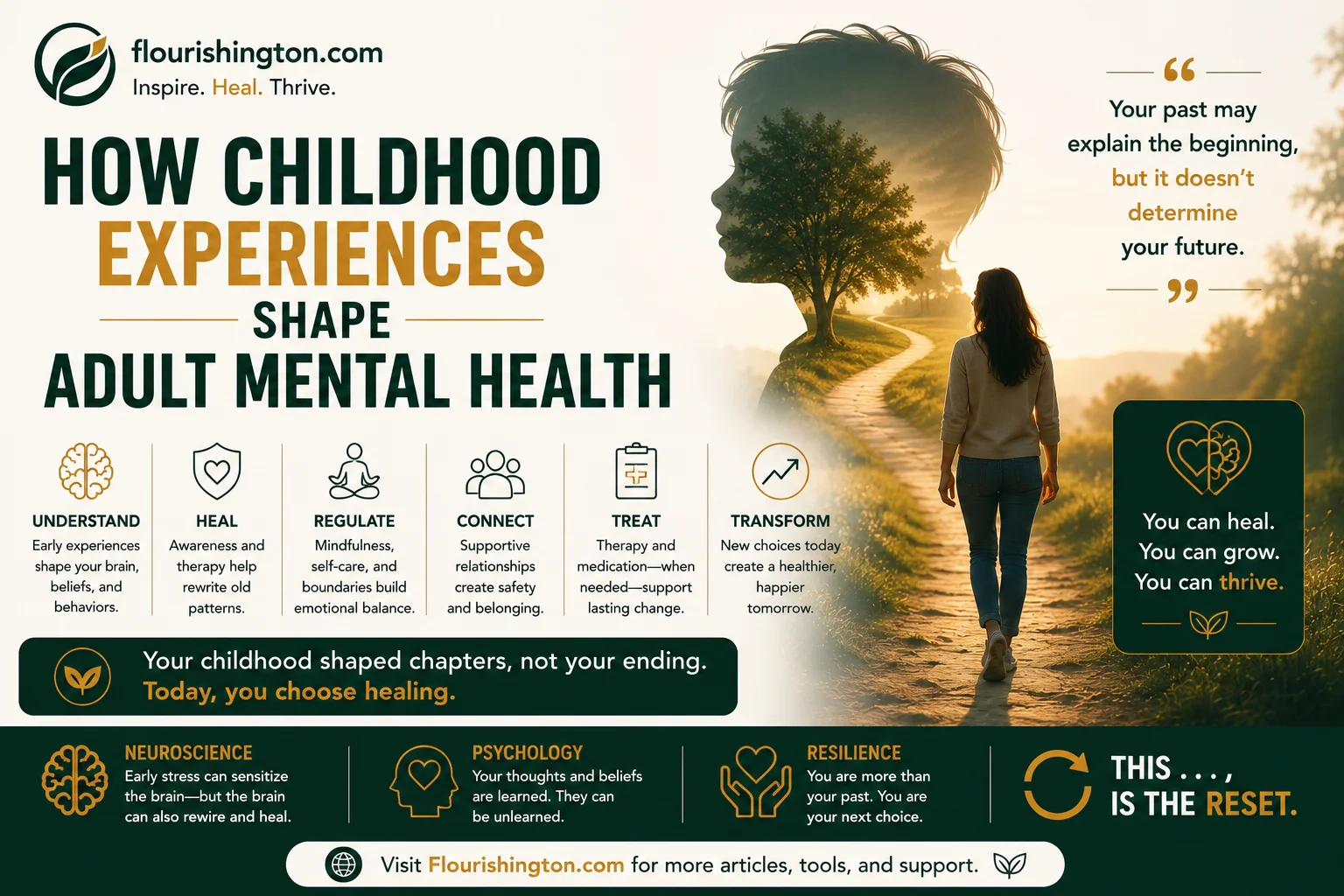

Your Childhood May Shape the Beginning of Your Story—But It Does Not Have to Write the Ending
Childhood eventually ends, but some of its emotional fingerprints can travel with us into adulthood.
The environments in which we first experienced love, safety, criticism, conflict, acceptance, rejection, consistency, or unpredictability can influence how we later understand ourselves and relate to others. An adult who struggles with abandonment, perfectionism, people-pleasing, hypervigilance, emotional withdrawal, or difficulty trusting may sometimes be responding through patterns learned much earlier.
But an important distinction matters:
Your childhood can influence you without permanently defining you.
Understanding where a pattern began is not about blaming the past. Therapeutically, it is about recognizing what was learned so healthier responses can be practiced today.
Childhood Helps Teach the Brain What to Expect
During childhood, the brain is developing rapidly and learning from repeated experiences.
When children consistently experience safety, responsiveness, and emotional support, their developing nervous systems receive repeated opportunities to associate relationships with predictability and security.
Chronic or severe childhood stress can create different adaptations. Brain systems involved in threat detection, stress regulation, attention, and emotional processing may become more sensitive to potential danger.
The amygdala helps identify emotionally significant threats, while the prefrontal cortex contributes to judgment, impulse regulation, planning, and emotional control. Stress-response systems involving the hypothalamic-pituitary-adrenal axis also help prepare the body to respond to adversity.
A child exposed to unpredictable or threatening environments may therefore learn:
“Stay alert.”
“Don’t trust too quickly.”
“Keep everyone happy.”
“Don’t make mistakes.”
“Protect yourself before someone hurts you.”
These responses may once have been adaptive.
The difficulty comes when yesterday’s protective strategy automatically becomes today’s response—even when today’s circumstances are different.
Early Relationships Can Become Adult Expectations
Psychologically, childhood experiences can influence attachment, self-worth, emotional regulation, conflict management, and beliefs about relationships.
A child repeatedly criticized may become an adult with a powerful inner critic. Someone whose emotional needs were inconsistently met may become highly sensitive to perceived rejection. Another person may avoid vulnerability because emotional distance once felt safer.
In cognitive terms, repeated experiences can contribute to deeply held beliefs such as:
“I’m not good enough.”
“People always leave.”
“I must earn love.”
“If I become vulnerable, I’ll get hurt.”
These beliefs can operate almost like invisible filters through which adult experiences are interpreted.
A delayed text becomes rejection.
Constructive feedback becomes failure.
Conflict becomes abandonment.
A mistake becomes proof of inadequacy.
Psychotherapy can help uncover these patterns and ask an essential question:
“Is this response based on what is happening now—or what I learned to expect then?”
That question can begin a powerful cognitive reset.
Childhood Adversity Is a Risk Factor, Not a Destiny
From a psychiatric perspective, adverse childhood experiences can be associated with increased vulnerability to later mental-health difficulties, including depression, anxiety, post-traumatic stress symptoms, substance-related problems, and difficulties with emotional regulation.
But increased vulnerability is not inevitability.
Genetics, temperament, severity and duration of adversity, protective relationships, socioeconomic circumstances, physical health, later experiences, coping strategies, and access to treatment can all influence outcomes.
This is why mental-health assessment should consider the whole person rather than reducing every adult difficulty to childhood trauma.
Your history provides clinical context. It does not automatically provide the diagnosis.
Nursing Care Begins With the Whole Person
A psychiatric nursing perspective asks not only, “What happened?” but also, “How are you functioning today?”
How are you sleeping? Eating? Concentrating? Managing stress? Maintaining relationships? Caring for your physical health? Are anxiety, depression, irritability, nightmares, avoidance, substance use, or intrusive memories interfering with daily functioning?
Assessment should also include strengths.
Who supports you? What has helped you survive difficult periods? What gives your life meaning? Which coping strategies are already working?
Good care recognizes both vulnerability and resilience.
Psychotherapy Can Help Rewrite Learned Patterns
Several evidence-based psychotherapies may help, depending on symptoms and diagnosis. Cognitive behavioral approaches can identify distorted or outdated beliefs and replace them with more balanced interpretations. Trauma-focused therapies may help appropriately selected individuals process traumatic experiences. Mindfulness, emotional-regulation skills, interpersonal work, and supportive psychotherapy can also strengthen healthier responses.
Try this cognitive restructuring exercise:
Old belief:
“My past controls me.”
Examine it:
“What evidence shows that I must respond today exactly as I learned to respond years ago?”
Reset:
“My past influenced some of my patterns. Today, I can practice healthier ones.”
Then translate insight into behavior.
Practice mindfulness before reacting. Establish boundaries where you previously overaccommodated. Journal recurring triggers and thoughts. Exercise regularly. Build relationships with people who demonstrate consistency and respect. Practice receiving healthy support rather than automatically expecting rejection.
New patterns become stronger through repetition.
Where Psychotropic Medication Fits
Medication does not erase childhood experiences, nor should every painful memory be medicated.
However, when someone develops a diagnosable psychiatric condition with clinically significant symptoms, psychotropic medication may sometimes be appropriate as part of an individualized treatment plan.
Depending on the diagnosis, symptoms, medical history, previous treatment response, adverse effects, interactions, and patient preferences, medication management might address conditions such as depression, anxiety disorders, trauma-related symptoms, or associated sleep disturbances.
Prescribing should involve careful assessment, appropriate monitoring, education about expected benefits and potential adverse effects, and regular evaluation of whether treatment remains necessary and effective.
For many people, medication and psychotherapy serve different but complementary purposes: medication may reduce symptom burden while therapy addresses thoughts, behaviors, relationships, coping, and underlying patterns.
Your Past Is History, Not a Life Sentence
Healing does not require denying what happened.
It means learning to recognize when an old survival strategy has entered a new situation.
Pause. Breathe. Examine the evidence. Set healthier boundaries. Move your body. Journal. Build safe relationships. Seek professional support when symptoms interfere with functioning.
And when an old voice says:
“This is simply who I am because of what happened to me,”
reset it:
“My childhood shaped some chapters of my story. Today, I can help write what comes next.”
Your childhood may explain some of your patterns.
It does not have to become your ending.
Choose healing. Practice new patterns. Build forward.
Visit Flourishington.com for more. This . . ., is THE RESET.
Written by David Fowope, MFA, PMHNP-BC